Kopparapu et al. (2013) Reproduction
I wanted to get back into astro like I did in college, so I reworked an old paper in an astro notebook.
Published on 10/22/2026
My goal was to reproduce Kopparapu et. all (2013) (https://iopscience.iop.org/article/10.1088/0004-637X/765/2/131#references) and show an updated Figure 8 using data from JWT.
The 2013 paper was missing a lot of information and actually needed an after publication correction. (https://iopscience.iop.org/article/10.1088/0004-637X/770/1/82) The linked online calculator was gone, the table of coefficients had been taken down, and the Fortran and Python code was also missing.
Through a little more research, Kopparapu had a new paper in 2014 (https://arxiv.org/pdf/1404.5292) with the new calculator and the updated table that calculator is using. (https://vpl.uw.edu/calculation-of-habitable-zones/) I updated my coefficients and got similar results as the 2014 calculator.
For the recreation of Figure 8 from the 2013 paper, I used the 2014 numbers. The 2014 paper does not give constants for "Moist Greenhouse" so I used the ones from 2013. The 2014 paper introduces more variables including the mass of the planets around a star. The paper finds this has a weight on the habitable zone around a star for that planet. I ignored the mass of planets to more closely recreate the original 2013 paper and to keep my project from becoming too complicated initially.
The Constants from Table 1 in Kopparapu et al. (2014)
Moist Greenhouse numbers from 2013 paper
| Constant | Recent Venus | Runaway Greenhouse | Maximum Greenhouse | Early Mars |
|---|---|---|---|---|
| Seff☉ | 1.776 | 1.107 | 0.356 | 0.32 |
| a | 2.136 × 10⁻⁴ | 1.332 × 10⁻⁴ | 6.171 × 10⁻⁵ | 5.547 × 10⁻⁵ |
| b | 2.533 × 10⁻⁸ | 1.58 × 10⁻⁸ | 1.698 × 10⁻⁹ | 1.526 × 10⁻⁹ |
| c | −1.332 × 10⁻¹¹ | −8.308 × 10⁻¹² | −3.198 × 10⁻¹² | −2.874 × 10⁻¹² |
| d | −3.097 × 10⁻¹⁵ | −1.931 × 10⁻¹⁵ | −5.575 × 10⁻¹⁶ | −5.011 × 10⁻¹⁶ |
Regenerate Figure 8 with NASA's current exoplanet list
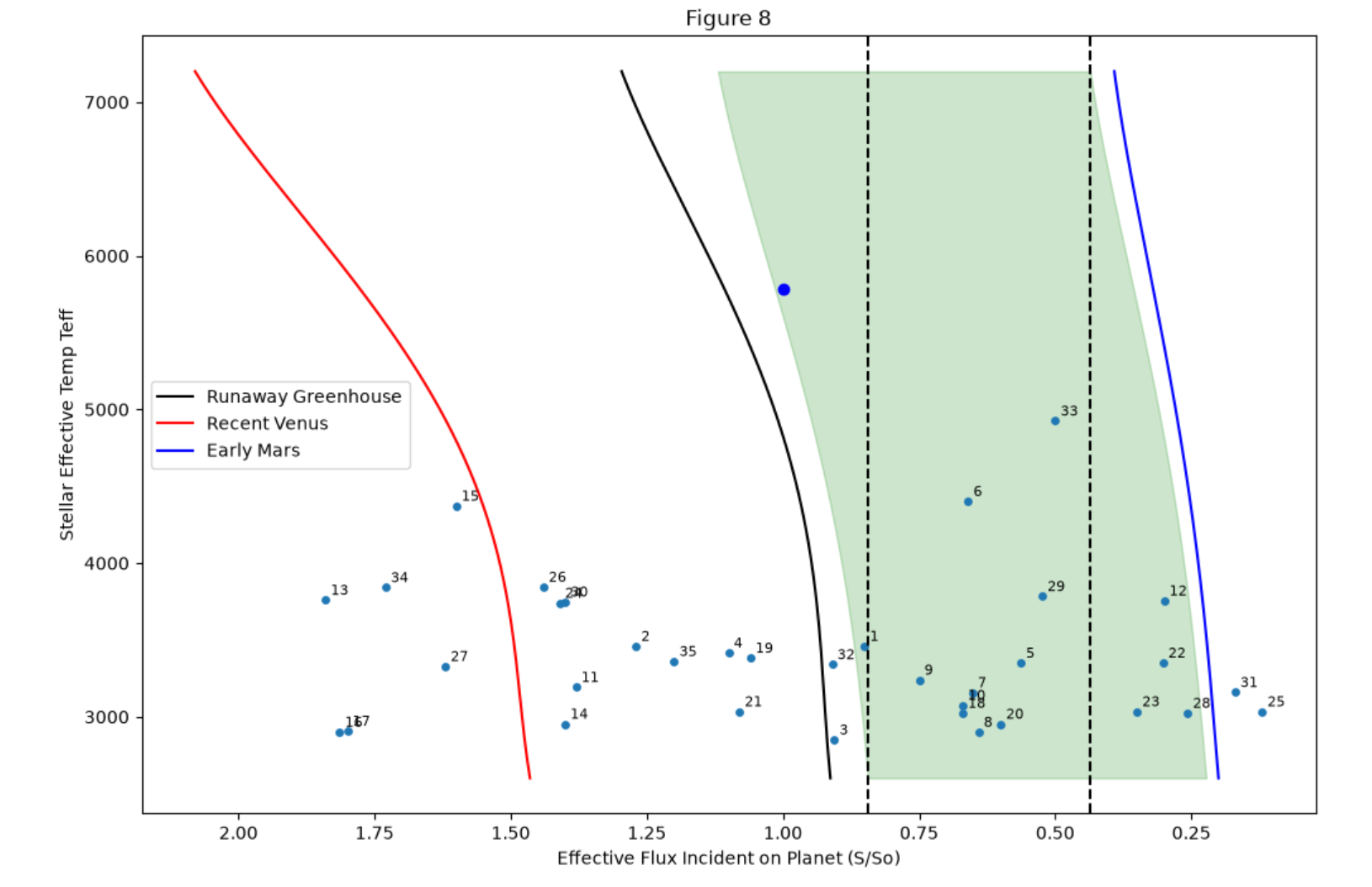
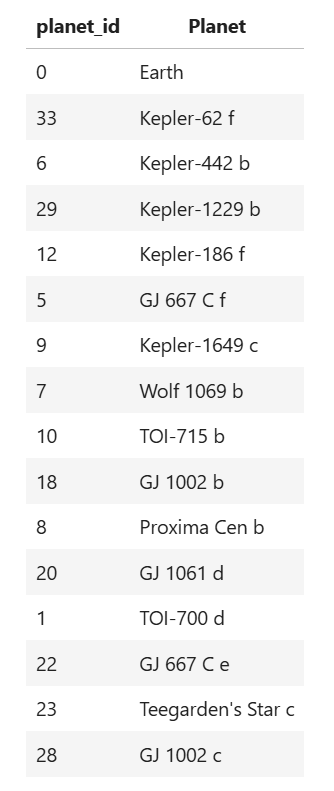
Figure 8 in Kopparapu et. all (2013) shows the known planets at the time, expressed in terms of effective stellar flux as a function of stellar Teff.
Planets Listed in the Habitable Zone
Conclusions
Figure 8 shows various HZ boundaries (expressed in terms of effective stellar flux) as a function of stellar Teff. The orbital parameters of the planets and stellar characteristics were obtained from nasaexoplanetarchive. The green-shaded habitable region is bounded by the moist-greenhouse limit (inner edge) and the maximum greenhouse limit (outer edge). A terrestrial mass planet that lies within the two vertical dashed lines in the green shaded region is in the HZ irrespective of the type of star it is orbiting. The corresponding flux boundaries for which a rocky planet is “definitely” in the HZ are 0.844 and 0.435.
For the full write-up and for my python calculator code, Check out my github
Comments (0)
Sign in to leave a comment.
Loading comments...